



Pourquoi la vitamine C est le complément le plus sous-estimé pour votre peau
La science du collagène, l'absorption liposomale, et pourquoi Altrient C change la donne.
Si vous vous êtes déjà demandé pourquoi votre peau perd son rebond, son galbe, cet éclat de « j'ai dormi dix heures », la réponse tient presque toujours en un mot : le collagène.
Le collagène est la protéine structurelle la plus abondante du corps humain. Il forme l'échafaudage qui soutient la peau, maintient la cohésion du cartilage, renforce les vaisseaux sanguins et traverse les tissus conjonctifs comme une trame qui garde l'ensemble ferme, souple et intact. Une peau saine et rayonnante est le résultat visible de fibres de collagène structurellement solides, bien entretenues et pleinement fonctionnelles.
Mais cet échafaudage se dégrade avec le temps, et la plupart d'entre nous n'en font pas assez pour le soutenir.

Le compte à rebours du collagène
La synthèse du collagène dans la peau diminue progressivement avec l'âge : les études évoquent généralement une baisse moyenne d'environ 1 % à 1,5 % par an à partir du début de l'âge adulte.(1) Cela peut sembler peu, mais les effets sont cumulatifs, et c'est la peau qui le montre en premier. Les ridules se creusent, l'élasticité s'atténue. La peau se pose différemment sur le visage : moins tendue, moins souple, moins vivante.
Il s'agit là d'un déficit structurel bien plus que d'un simple vieillissement. Et comme pour tout problème de structure, la solution la plus efficace n'est pas de le masquer de l'extérieur, mais de renforcer les fondations de l'intérieur.
Cela commence par comprendre ce qui construit réellement le collagène dans l'organisme.
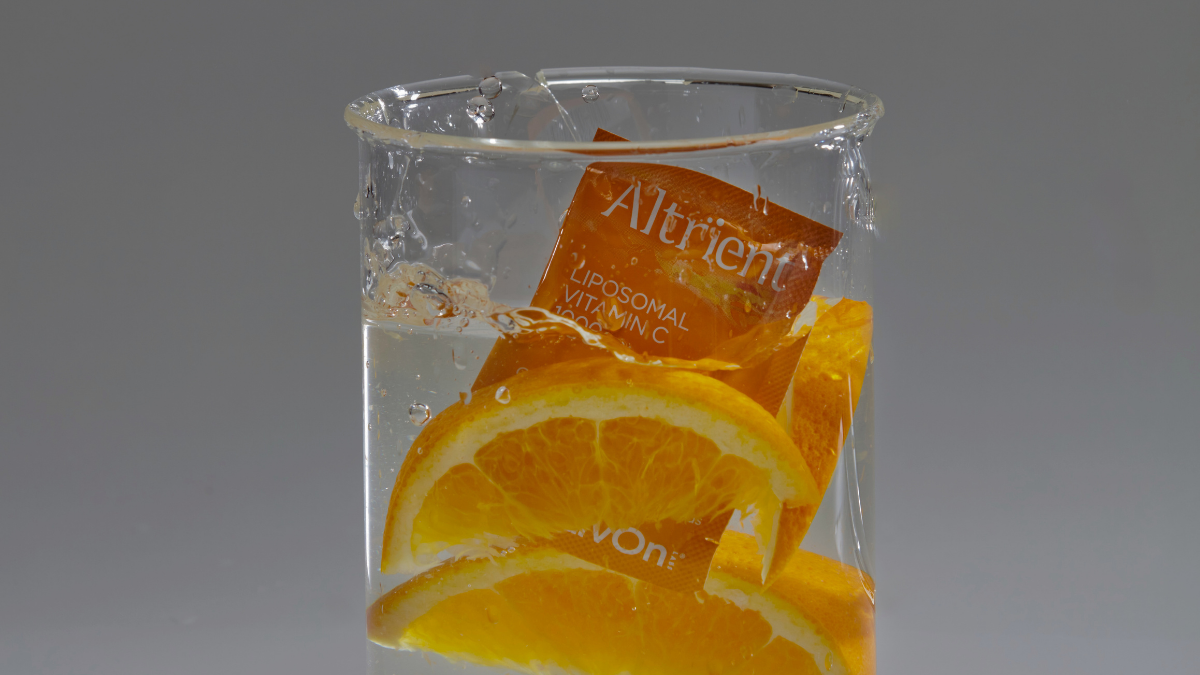
Le rôle essentiel de la vitamine C dans la formation du collagène
La vitamine C jouit d'une solide réputation en matière de soutien immunitaire, mais son lien avec la peau va bien plus loin que la plupart des gens ne l'imaginent.
La vitamine C joue un rôle clé dans la synthèse du collagène. Elle intervient à la fois dans la stabilisation enzymatique des fibres de collagène et dans l'activité des fibroblastes qui les produisent. Son rôle dépasse le simple appui : sans un apport suffisant en vitamine C, l'organisme est tout simplement incapable de produire ou d'entretenir correctement le collagène. La proline et la lysine, les deux acides aminés qui donnent au collagène sa structure, doivent être hydroxylées pour que la molécule tienne correctement. Or ce processus ne peut pas avoir lieu sans vitamine C, qui en est un cofacteur essentiel.
Autrement dit : pas de vitamine C, pas de collagène stable.
Comment le corps fabrique réellement le collagène
Pour comprendre pourquoi cela compte, il faut d'abord comprendre comment le collagène est fabriqué.
Le collagène n'est pas une substance que l'on peut manger et absorber telle quelle. Il est fabriqué à l'intérieur du corps, au terme d'un processus en plusieurs étapes qui se déroule dans des cellules spécialisées : les fibroblastes.
Les fibroblastes sont des cellules du tissu conjonctif réparties dans le derme, la couche profonde de la peau située sous la surface. Leur mission première est l'entretien structurel : produire et organiser les protéines qui gardent la peau ferme, le cartilage souple et la paroi des vaisseaux sanguins intacte. Lorsque tout fonctionne bien, ils déposent en permanence de nouvelles fibres de collagène et remodèlent les plus anciennes.
Le processus débute à l'intérieur même du fibroblaste. La cellule assemble les molécules de collagène à partir d'acides aminés, principalement la proline et la glycine, dans une structure appelée réticulum endoplasmique. À ce stade, ces molécules portent le nom de procollagène et ne sont pas encore structurellement utilisables : certaines modifications doivent d'abord avoir lieu.
C'est ici que la proline et la lysine deviennent déterminantes. Pour que le procollagène forme une triple hélice stable, certains résidus de proline et de lysine doivent être hydroxylés. Sans cette modification, la molécule reste instable et ne peut pas s'assembler correctement en fibres de collagène.
Une fois hydroxylé, le procollagène est libéré par la cellule, puis transformé par des enzymes extracellulaires. Il s'assemble alors naturellement en fibrilles de collagène, qui se regroupent en fibres contribuant à soutenir l'architecture de la peau. La vitamine C est essentielle en amont de ce processus, car elle permet l'hydroxylation des résidus de proline et de lysine. (2)
Ce que fait la vitamine C à l'intérieur du fibroblaste
Les enzymes qui assurent l'hydroxylation, la prolyl-hydroxylase et la lysyl-hydroxylase, ont besoin de la vitamine C comme cofacteur pour fonctionner de manière optimale. Sans apport suffisant, l'hydroxylation est perturbée, le procollagène est moins stable et la maturation du collagène s'en trouve compromise.(3,4)
Mais le rôle de la vitamine C dans le fibroblaste ne s'arrête pas à cette seule étape. Les recherches suggèrent qu'elle pourrait également influencer l'expression des gènes liés au collagène et contribuer à la production des types de collagène les plus importants pour la structure cutanée.(3,4)
Le collagène n'est pas une protéine unique. On en compte au moins 28 types distincts, chacun doté d'une structure et d'un rôle propres dans l'organisme.
Le type I est le plus abondant dans la peau : il lui apporte résistance et fermeté.(5,6) Le type III est produit parallèlement et contribue à l'élasticité et à la souplesse.(5,6) Ces deux types agissent ensemble dans le derme, et leur équilibre évolue avec l'âge.(5,6)
Certaines données indiquent également que la vitamine C pourrait aider à protéger le collagène en soutenant les défenses naturelles de l'organisme contre sa dégradation et contre le stress oxydatif. (3,4) Un certain renouvellement du collagène est normal et nécessaire, mais lorsque le stress oxydatif et l'inflammation sont élevés, la dégradation peut prendre le pas sur la réparation. La vitamine C pourrait aider à maintenir l'équilibre entre synthèse et dégradation du collagène.(3,4)
En résumé, la vitamine C aide les fibroblastes à produire un collagène stable et pourrait aussi contribuer à protéger la matrice de collagène d'une dégradation excessive.(3-7)
Une vision plus large
La contribution de la vitamine C ne s'arrête pas là : c'est aussi un antioxydant important pour la peau, qui aide à protéger les cellules et les structures extracellulaires du stress oxydatif provoqué par l'exposition aux UV, la pollution et le métabolisme normal. Elle contribue en outre indirectement à la stabilité du collagène en limitant les dommages oxydatifs susceptibles d'accélérer sa dégradation.
La vitamine C pourrait également jouer un rôle dans la régulation de la pigmentation. Elle est couramment utilisée en cosmétique contre les irrégularités du teint et les taches brunes, car elle pourrait aider à réduire la production excessive de mélanine, qui joue un rôle clé dans la pigmentation.(8) Elle participe aussi au soutien de la barrière cutanée, en créant les conditions favorables à une bonne réparation de la peau et en préservant les lipides qui la maintiennent résistante et hydratée.
Ces trois bénéfices supplémentaires, protection antioxydante, régulation de la pigmentation et soutien de la barrière cutanée, dépendent de la même condition que la synthèse du collagène : la présence de vitamine C en concentration suffisante au niveau cellulaire.
Pourquoi la plupart des produits au collagène abordent l'élasticité de la peau à l'envers
Face à la perte de collagène, la plupart des gens se tournent vers des boissons, des poudres ou des crèmes. La logique se comprend, mais la science est moins évidente que ne le laisse entendre le marketing. Le collagène alimentaire est décomposé en acides aminés lors de la digestion, comme n'importe quelle autre protéine : il ne se dirige pas directement vers la peau. Quant au collagène en application topique, il agit surtout comme un agent hydratant et filmogène, sans acheminer de collagène intact jusqu'au derme, là où se trouvent les fibroblastes.
L'approche la mieux étayée scientifiquement consiste à soutenir la machinerie de production de collagène de l'organisme lui-même : la fonction des fibroblastes, le statut en vitamine C, et un apport suffisant en protéines et en micronutriments.
 Soutenir le collagène là où tout commence
En donnant à l'organisme ce dont il a besoin pour faire le travail lui-même, au niveau cellulaire, vous soutenez les processus qui contribuent à préserver l'aspect sain de la peau dans la durée. Cela suppose de privilégier un apport en vitamine C sous une forme que le corps peut réellement absorber, et de soutenir la fonction des fibroblastes avec les nutriments nécessaires à la production et à l'entretien du collagène.
Cela suppose aussi de regarder au-delà du marketing, du côté des preuves qui distinguent un complément véritablement efficace de tout le reste. La vraie question n'est pas de savoir si un produit contient de la vitamine C, mais s'il la délivre d'une manière qui en permet une assimilation et une utilisation réelles.
 Pourquoi l'absorption fait toute la différence
L'organisme peut se montrer étonnamment réticent à absorber les nutriments administrés en grande quantité d'un seul coup. Avec les comprimés ou gélules de vitamine C classiques, l'absorption devient moins efficace à mesure que la dose augmente : une part plus importante du nutriment risque d'être éliminée plutôt qu'utilisée. C'est pourquoi la formulation compte autant que le dosage, et c'est là que la technologie liposomale peut faire la différence.
Les liposomes sont de minuscules sphères lipidiques qui encapsulent les nutriments, contribuant à les protéger pendant la digestion et à favoriser leur acheminement. Leur structure étant proche de celle des membranes cellulaires humaines, elle facilite le passage des nutriments à travers la paroi intestinale jusque dans la circulation sanguine.
Globalement, la technologie liposomale vise à améliorer l'acheminement des nutriments et leur tolérance. Il s'agit d'une forme de biodisponibilité fondamentalement différente, qui ne dépend ni de cofacteurs ni du dosage.
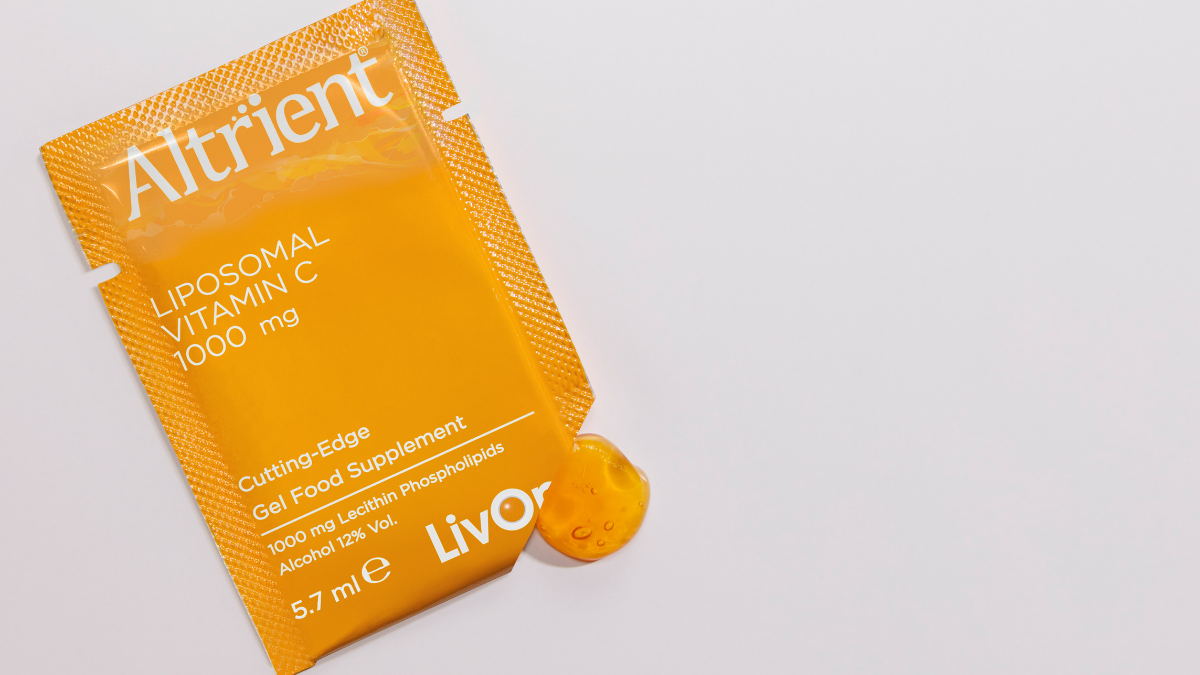 La différence Altrient C
La vitamine C liposomale Altrient a fait l'objet d'une étude clinique indépendante, dont les résultats montrent une amélioration significative de la fermeté et de l'élasticité de la peau, avec une hausse de 61 % sur 12 semaines. Un exemple convaincant de la façon dont un complément de vitamine C bien formulé peut contribuer à soutenir la structure de la peau de l'intérieur.
Ce qui semble compter le plus, ce n'est pas seulement la vitamine C elle-même, mais le système de délivrance qui l'accompagne. L'étude suggère que la formulation liposomale spécifique d'Altrient C a été associée à des bénéfices cutanés mesurables dans le délai d'un essai cosmétique standard. Si les résultats obtenus avec un produit ne peuvent pas être automatiquement transposés à tous les compléments de vitamine C, ils mettent en évidence l'influence de la formulation et de la biodisponibilité sur l'efficacité.
Le mécanisme avancé pour expliquer ces résultats est l'action biochimique conjointe d'une vitamine C fortement dosée et bien absorbée, associée à la technologie liposomale brevetée d'Altrient.
Autrement dit, le véritable atout d'une supplémentation en vitamine C ne tient peut-être pas seulement au nutriment lui-même, mais à l'efficacité avec laquelle il atteint les cellules qui en ont le plus besoin. Bien acheminée, la vitamine C est davantage en mesure de soutenir la production de collagène, d'aider à protéger la structure de la peau et de contribuer à un teint plus sain.
RÉFÉRENCES
-
Myung S, Park Y. Effects of Collagen Supplements on Skin Aging: A Systematic Review and Meta-Analysis of Randomized Controlled Trials
The American Journal of Medicine, 2025; 138, 1264-1277 -
Boyera N, Galey I, Bernard BA. Effect of vitamin C and its derivatives on collagen synthesis and cross-linking by normal human fibroblasts. Int J Cosmet Sci. 1998 Jun;20(3):151-8. doi: 10.1046/j.1467-2494.1998.171747.x. PMID: 18505499.
-
Prockop DJ, Kivirikko KI. Collagens: molecular biology, diseases, and potentials for therapy. Annu Rev Biochem. 1995;64:403-434. doi:10.1146/annurev.bi.64.070195.002155 (1)
-
Pullar JM, Carr AC, Vissers MCM. The roles of vitamin C in skin health. Nutrients. 2017;9(8):866. doi:10.3390/nu9080866 (2)
-
Savini I, Catani MV, Rosini F, et al. Vitamin C and collagen synthesis: a review. Int J Cosmet Sci. 2013;35(3):245-252. doi:10.1111/ics.12024 (3)
-
Ricard-Blum S. The collagen family. Cold Spring Harb Perspect Biol. 2011;3(1):a004978. doi:10.1101/cshperspect.a004978 (4)
-
Gelse K, Pöschl E, Aigner T. Collagens—structure, function, and biosynthesis. Adv Drug Deliv Rev. 2003;55(12):1531-1546. doi:10.1016/j.addr.2003.08.002 (5)
-
Sanadi RM, Deshmukh RS. The effect of Vitamin C on melanin pigmentation - A systematic review. J Oral Maxillofac Pathol. 2020 May-Aug;24(2):374-382. doi: 10.4103/jomfp.JOMFP_207_20. Epub 2020 Sep 9. PMID: 33456250; PMCID: PMC7802860.
Featured product
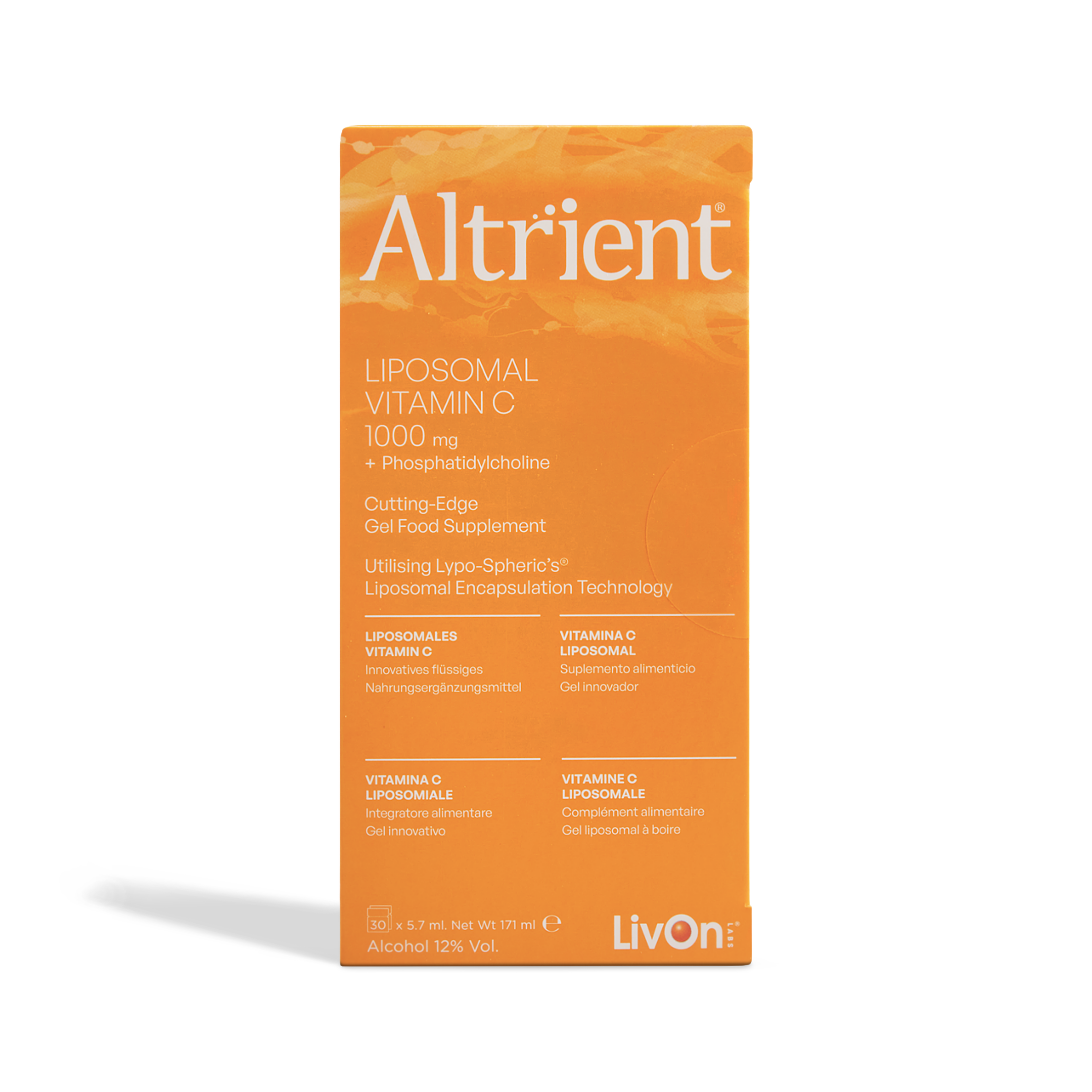
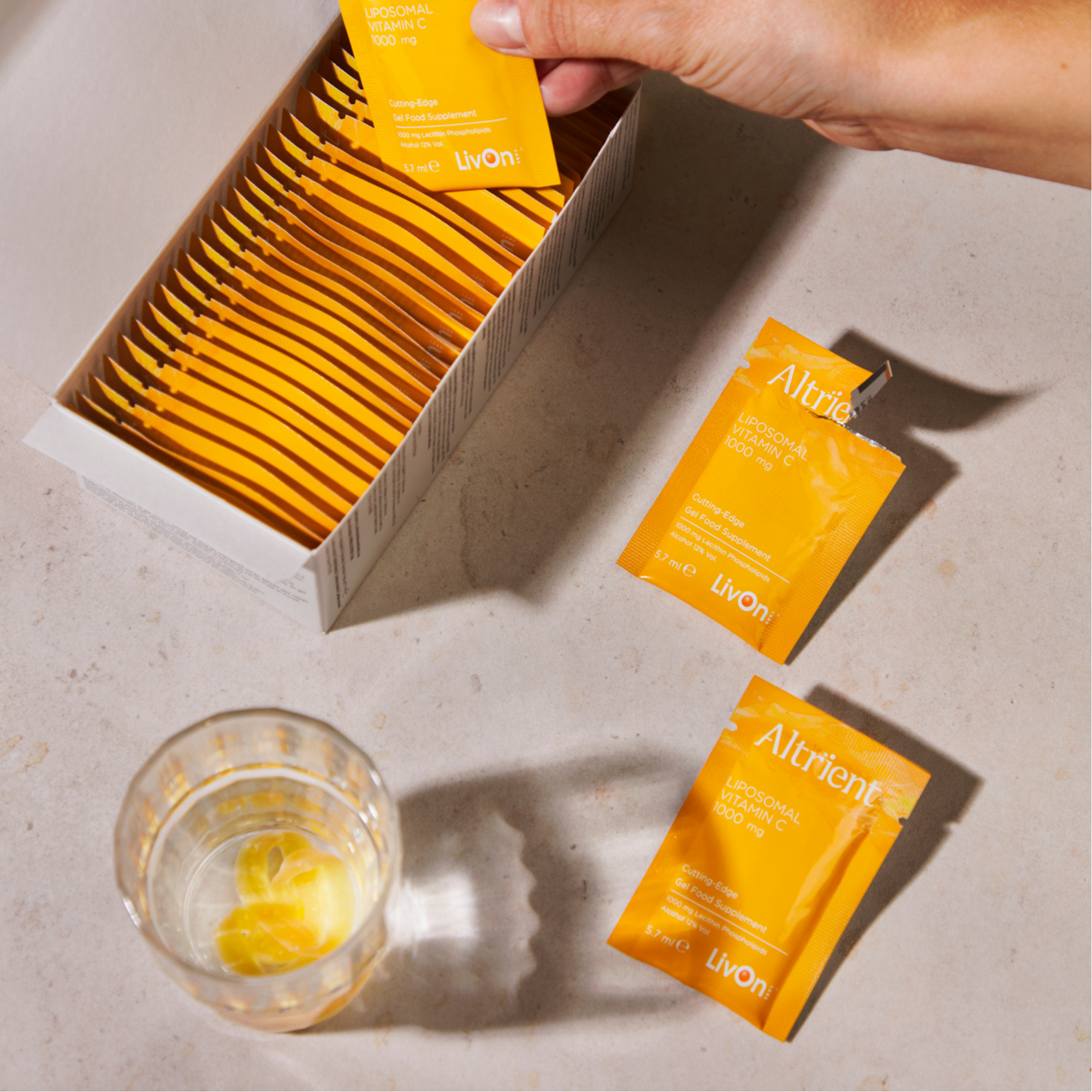
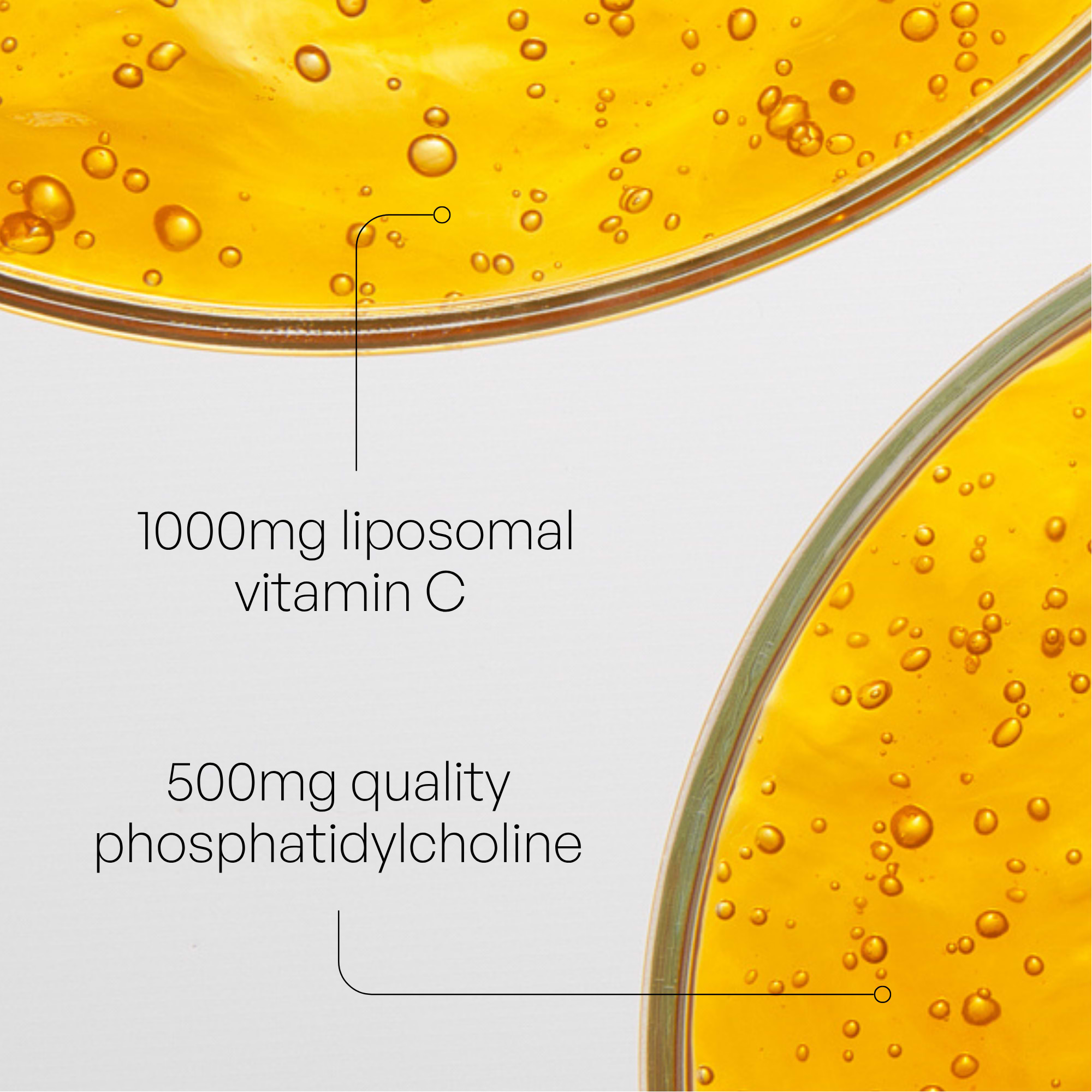
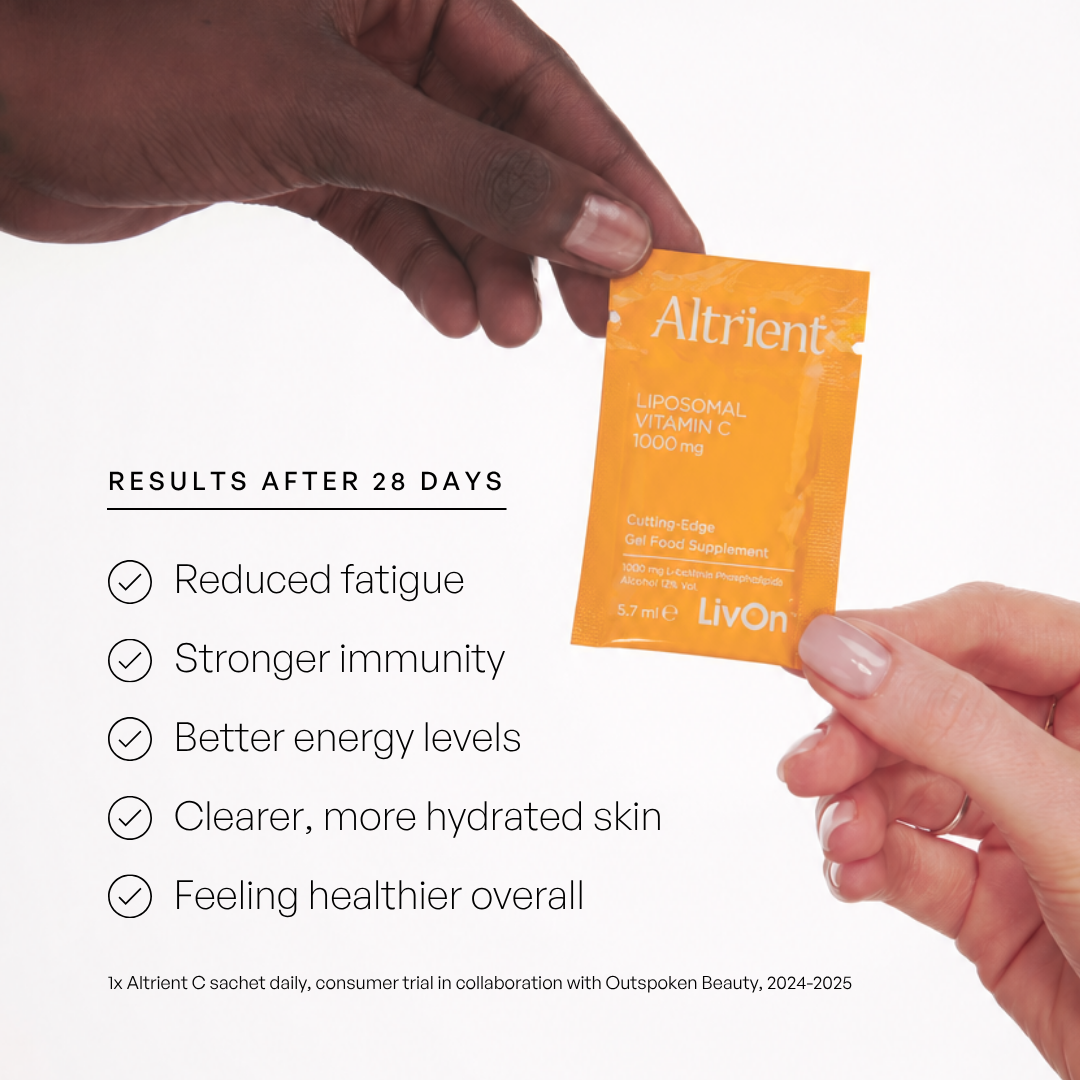

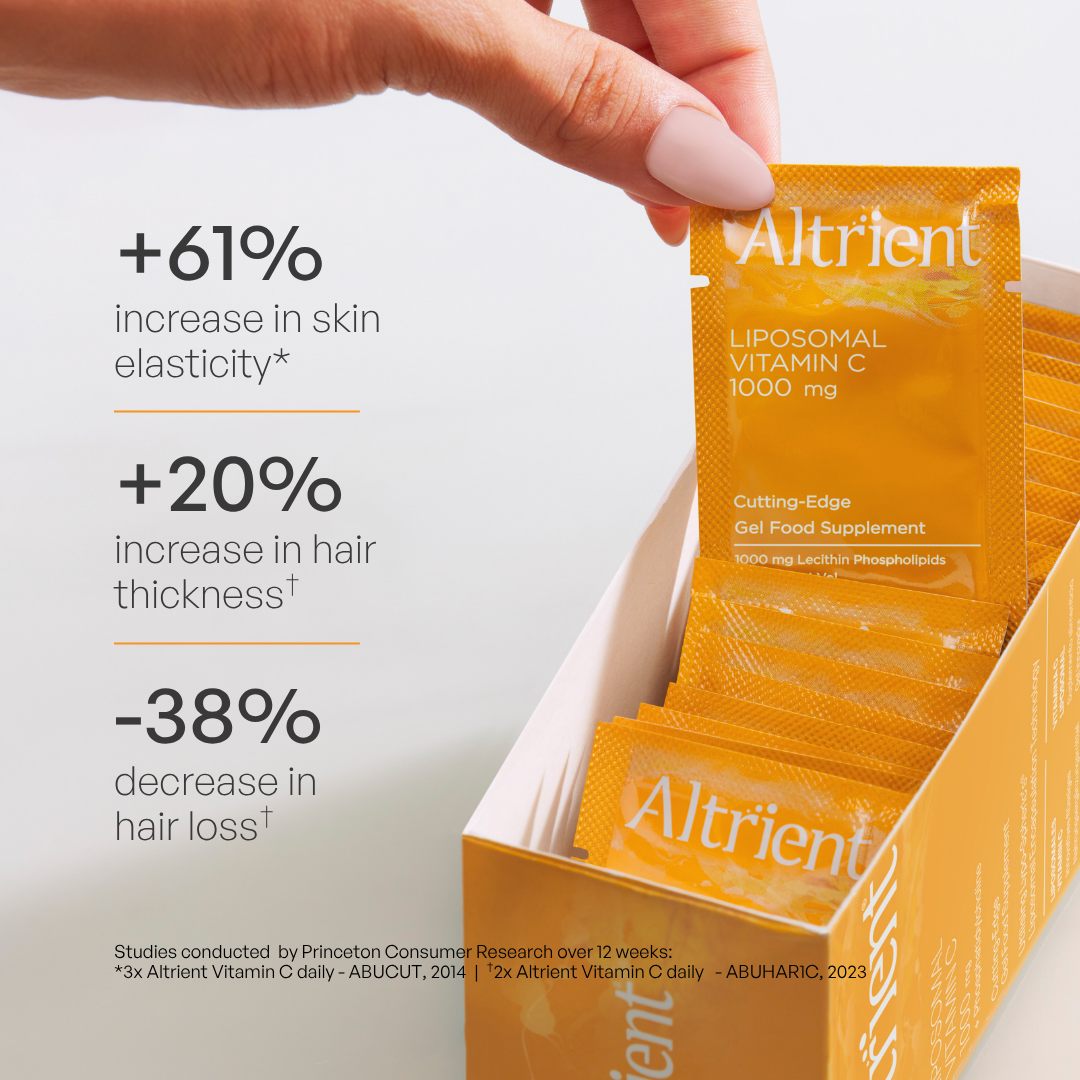
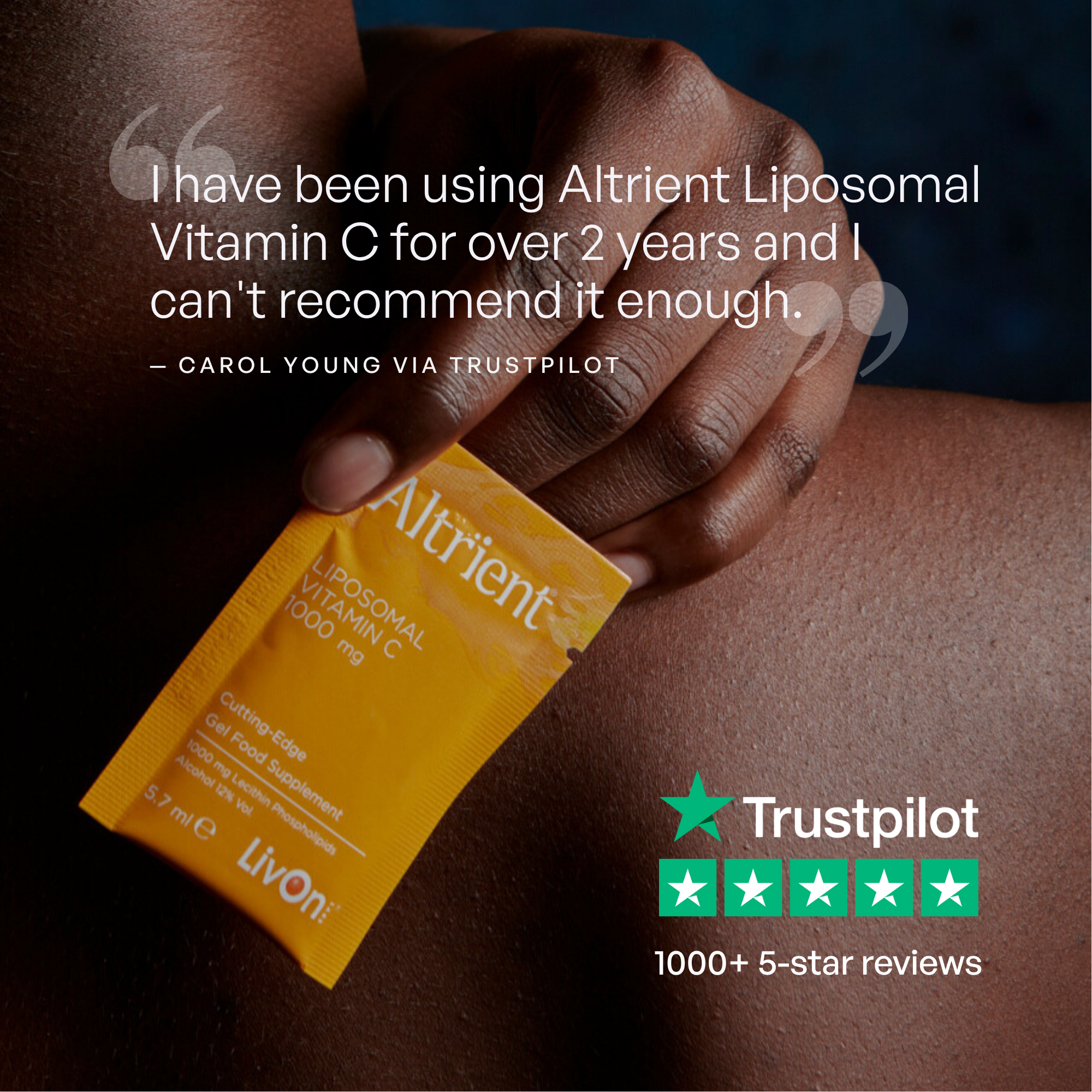

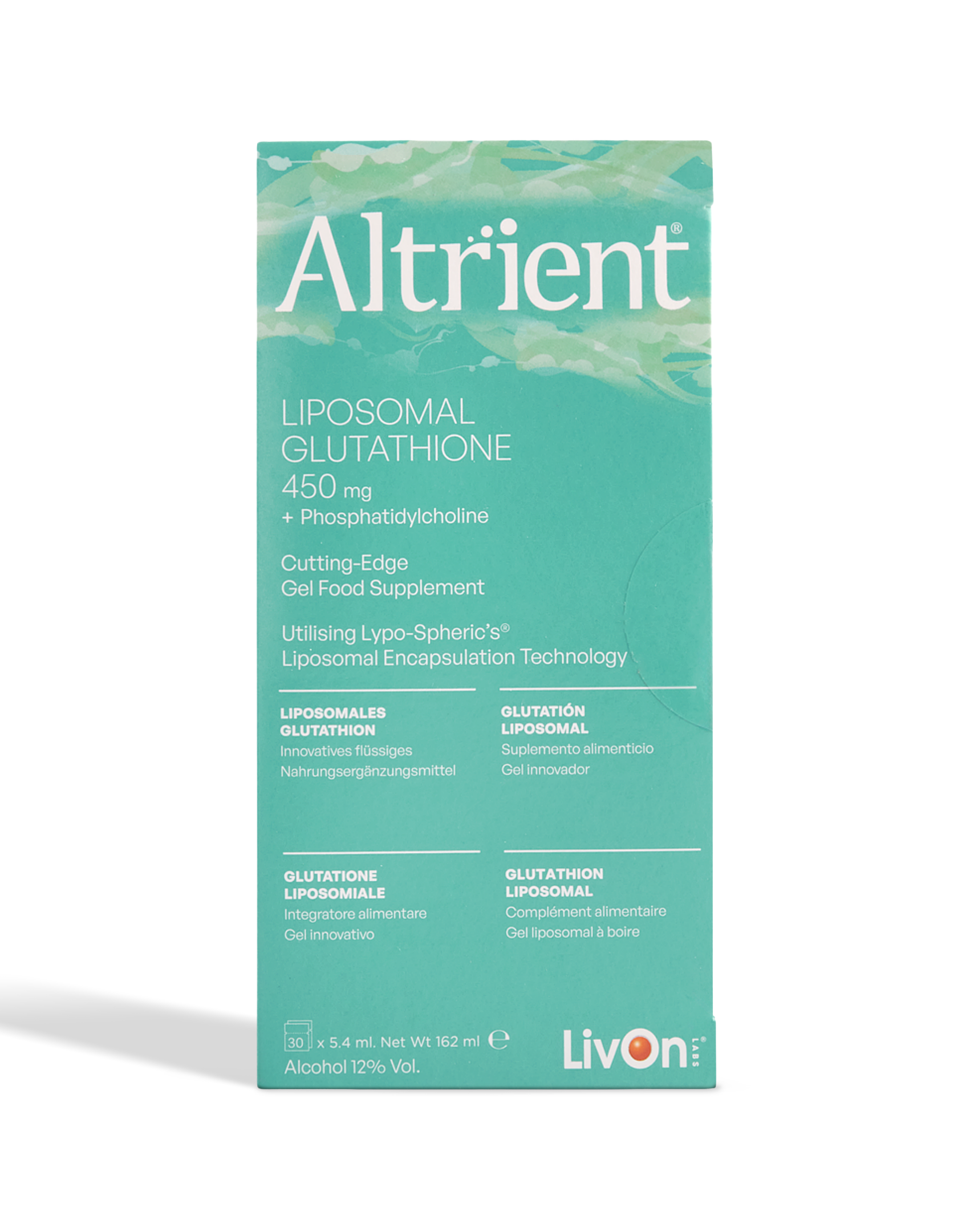
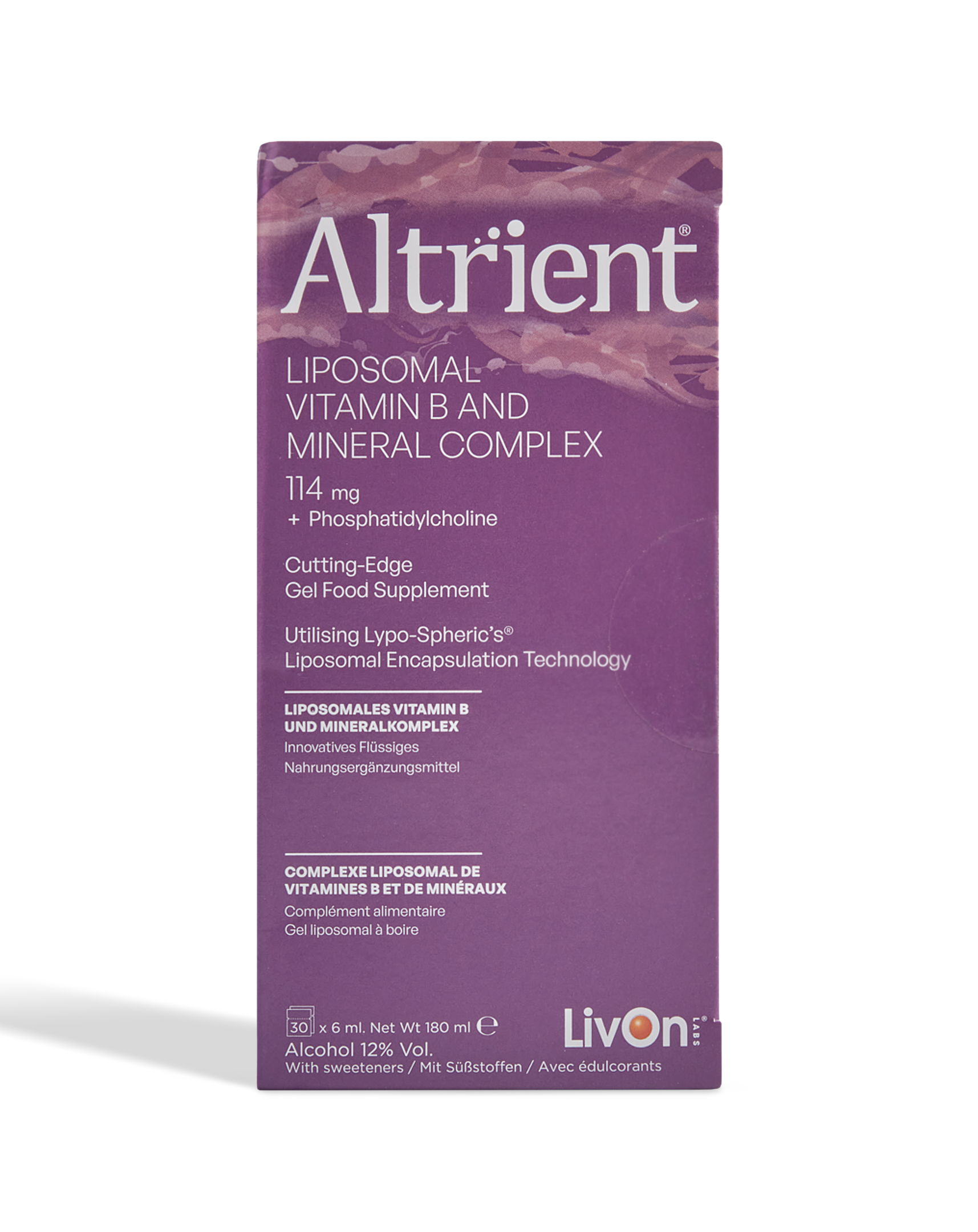
Altrient C est un complément alimentaire à la vitamine C liposomale maintes fois primé, fournissant 1 000 mg de vitamine C sous forme d’ascorbate de sodium doux pour l'estomac et 500 mg de phosphatidylcholine par sachet. Grâce à sa technologie liposomale brevetée en 2004, il offre une véritable encapsulation liposomale conçue pour améliorer l’absorption et la biodisponibilité de la vitamine C. Formulé avec seulement cinq ingrédients, il est sans arôme et sans édulcorant, et conditionné en sachets individuels afin de préserver la stabilité des liposomes. Testé à trois reprises pour garantir sa performance et sa pureté, Altrient C convient aux végétaliens et est exempt de sucres, d’édulcorants, de colorants, d’arômes, de gluten, de produits laitiers, d’ingrédients OGM et de tout autre ingrédient d’origine animale.
En lire plus

Même avec les meilleures intentions, parvenir à une alimentation parfaitement équilibrée et riche en nutriments chaque jour peut s'avérer difficile. L'appauvrissement des sols, la transformation de...

Summer often feels like the healthiest time of year. More sunlight. More movement. More time outdoors. Holidays, fresh food, sea air and longer days. But while we may feel better during summer, ski...